


EU Microplastics Restriction: 2027 Reporting Deadline and Affected Sectors
Overview
From 2027, the reporting scope under the EU restriction on synthetic polymer microparticles (SPM) will extend well beyond the narrower 2026 feedstock‑focused obligation.
Under REACH Entry 78, synthetic polymer microparticles (SPM) are essentially defined as:
- Solid synthetic polymer particles smaller than 5 mm,
- Insoluble and non‑degradable,
- Intentionally added to products and can be released to the environment.
The definition also covers fibres: synthetic polymer fibres with a length of less than 15 mm and a length‑to‑diameter ratio greater than 3, when they are similarly insoluble, non‑degradable and intentionally used.
This annual reporting duty under Entry 78 of Annex XVII to REACH, introduced by Commission Regulation (EU) 2023/2055, concerns estimated emissions of SPM to the environment from uses that benefit from derogations rather than being subject to an immediate placing‑on‑the‑market ban.
Manufacturers and industrial downstream users using SPM at industrial sites for derogated uses, as well as certain suppliers placing products containing derogated SPM on the EU market for professional users or consumers, must submit their first report by 31 May 2027, covering emissions that occurred in calendar year 2026.
What changes in 2027
The first reporting wave, due in 2026, focused primarily on manufacturers and industrial users of SPM used as plastic feedstock (e.g. pellets, flakes and powders). The 2027 deadline broadens the obligation to a wider set of derogated uses intentionally containing SPM, making the requirement relevant to more industrial sectors and formulated product supply chains.
In legal terms, the reporting obligation now clearly covers SPM used in the following derogated use categories:
- Use of SPM at industrial sites.
- Medicinal products for human and veterinary use within the scope of Directive 2001/83/EC and Regulation (EU) 2019/6.
- Food additives covered by Regulation (EC) No 1333/2008.
- In vitro diagnostic medical devices within the scope of Regulation (EU) 2017/746.
- SPM that are contained by technical means during their use to prevent releases to the environment, permanently modified during intended end use so that they no longer meet the SPM definition, or permanently incorporated into a solid matrix.
For each of these derogated use categories, the obligation is to estimate and annually report emissions of SPM to the environment.
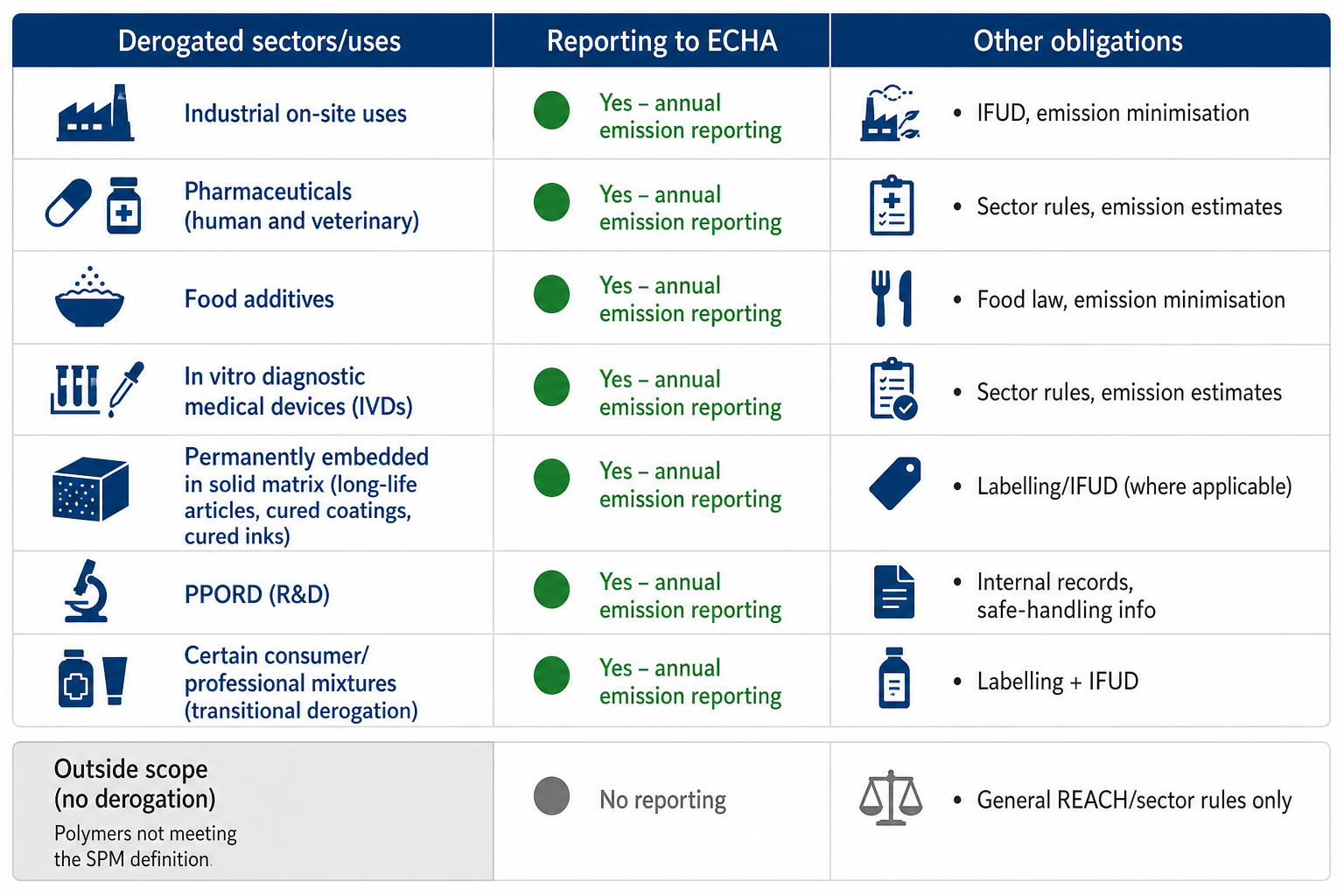
Affected sectors
The 2027 reporting deadline is relevant for sectors where SPM remains in use under derogations or transitional arrangements.
- Manufacturers and industrial users operating sites where SPM are used.
- Human and veterinary medicinal product value chains where formulations or processes intentionally include SPM.
- Food additive producers and related suppliers using SPM.
- In vitro diagnostic device manufacturers whose reagents or components contain SPM.
- Coatings, sealants, adhesives and construction products with SPM permanently embedded in cured or solid matrices.
- Suppliers of industrial specialty chemicals, resins, ion‑exchange and processing aids incorporating derogated SPM.
- Cosmetics and personal care brands using film‑forming polymers, microcapsules or other intentional SPM under transitions.
- Detergent, cleaner, wax and polish formulators relying on SPM for technical performance or controlled release.
- Fragrance houses and consumer‑goods suppliers using microencapsulated SPM systems under applicable derogations or phase‑out periods.
The exact scope must always be checked case by case against the legal wording of Entry 78, because not every polymer-containing product is an SPM and not every SPM-containing use benefits from a derogation.
Deadline and reporting expectation
The associated deadline is 31 May 2027, covering emissions data for calendar year 2026. Reporting must be submitted to ECHA using IUCLID through REACH-IT, and ECHA has published guidance to support companies in preparing the required dossier content and data structure. REACHLaw supports you with the reporting obligation.
In practical terms, companies should be ready to document the identity and use profile of the relevant SPM, its technical function, estimated environmental emissions and certificate when available, and the operational or technical measures used to limit releases where relevant.
Why companies should act early
For many affected companies, the main challenge lies less in pure legal interpretation and more in operational data collection and internal alignment. SPM uses are often embedded in additives, microcapsules, masterbatches or third‑party raw materials that have not previously been tracked in a way that supports annual emissions reporting.
A practical preparation plan should include: a structured scope screening against the SPM definition and Entry 78 derogations, targeted supplier and customer communication, design of internal data fields and processes for 2026 records (including emissions estimation methodologies), and early testing of IUCLID dossier creation and the REACH‑IT submission workflow well ahead of the 31 May 2027 deadline.
REACHLaw offers
- Portfolio mapping for Entry 78
- SPM use scope screening
- Derogation and transition assessment
- Emission estimation methodology support
- IUCLID/REACH‑IT reporting preparation
- Labelling and IFUD drafting
- Supply‑chain communication on SPM
- Compliance training on microplastics
Contact us at sales@reachlaw.fi for support!
Never miss a story
Stay updated about REACHLaw Blog as it happens