


Regulation In Brief
The Bureau of Indian Standards (BIS) is the national standardization body of India. The BIS Act, 2016, along with the associated Rules and Regulations, provides a framework for offering third-party assurance of the quality, safety, and reliability of products to consumers.
Under the BIS Act, 2016, BIS Rules, 2018, and BIS (Conformity Assessment) Regulations, 2018, provisions for the Grant of Licence (GoL) are outlined. These regulations apply to both domestic and foreign manufacturers seeking BIS registration for products listed under Scheme II.
Quality Control Orders (QCOs)
Quality Control Orders (QCOs) are mandatory directives issued by the Central Government of India under the BIS Act, 2016. These orders make BIS certification compulsory for specific products before they can be manufactured, imported, sold, distributed, or stored in India. Once a QCO comes into effect, no person can deal in the covered products without a valid registration.
Ministry of Electronics & Information Technology (MeitY), Ministry of New and Renewal Energy (MNRE), Ministry of Chemicals and Fertilizers and Ministry of Textiles has notified QCO under compulsory registration scheme.
Bureau of Indian Standards grants registration to the manufacturers to use or apply Standard Mark with unique R-number, through registration based on self-declaration of conformity for goods and articles as per Indian Standards. The grant of licence and its operation under Compulsory Registration Scheme are carried out as per the conformity assessment scheme under Scheme – II of Schedule – II of BIS (Conformity Assessment) Regulations, 2018
As per the Orders, no person shall manufacture or store for sale, import, sell or distribute goods which do not conform to the Indian standard specified in the order and do not bear the Standard Mark with unique registration number obtained from BIS.
Manufacturers and importers are advised to regularly check the BIS website for the latest list of products under compulsory registration scheme.
Foreign Manufacturers
Foreign manufacturers can obtain registration to use the Standard Mark on products that comply with the applicable Indian Standards under the Compulsory Registration Scheme.
To apply, the manufacturer must appoint an Authorized Indian Representative (AIR). The application process is online, and the overall timeline for obtaining the licence is 1-2 months excluding testing.
Domestic Manufacturers
Domestic manufacturers can obtain a registration to use the Standard Mark on products that comply with the applicable Indian Standards under the Compulsory Registration Scheme.
The application process is conducted online, and the typical timeline for obtaining certification is approximately 1–2 months excluding testing.
Product Categories Supported by REACHLaw
Click on the product category of your interest:
- Electronics and Information Technology Goods
- Solar Photovoltaics, Systems, Devices and Components
- Chemicals
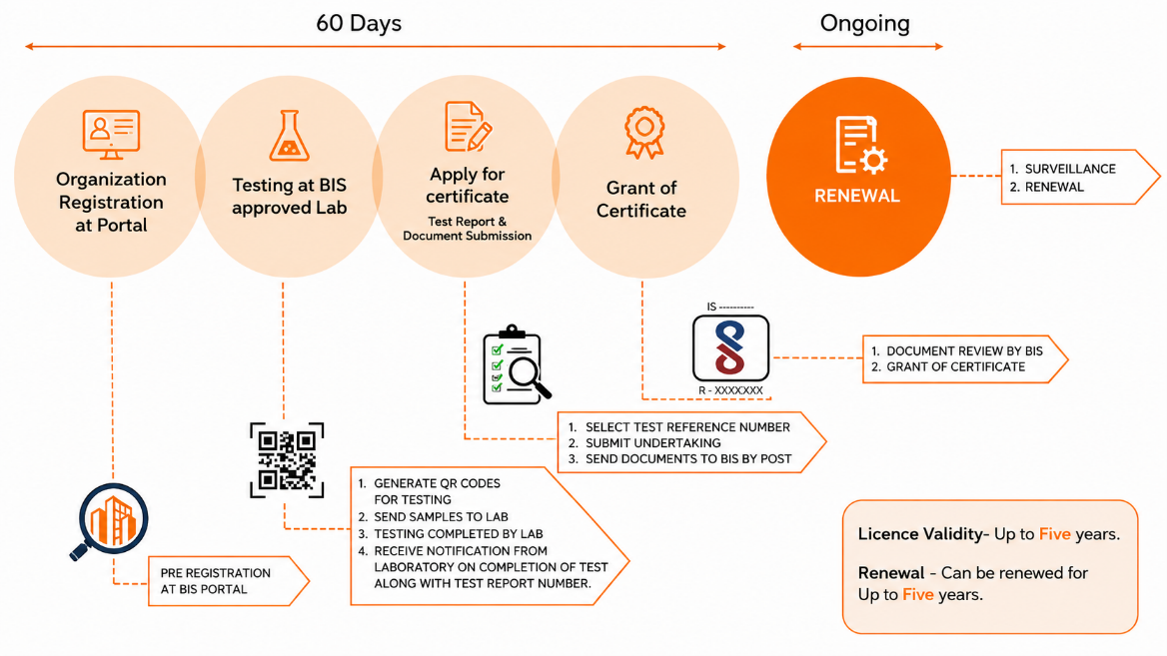
Process for Getting Compulsory Registration Certificate
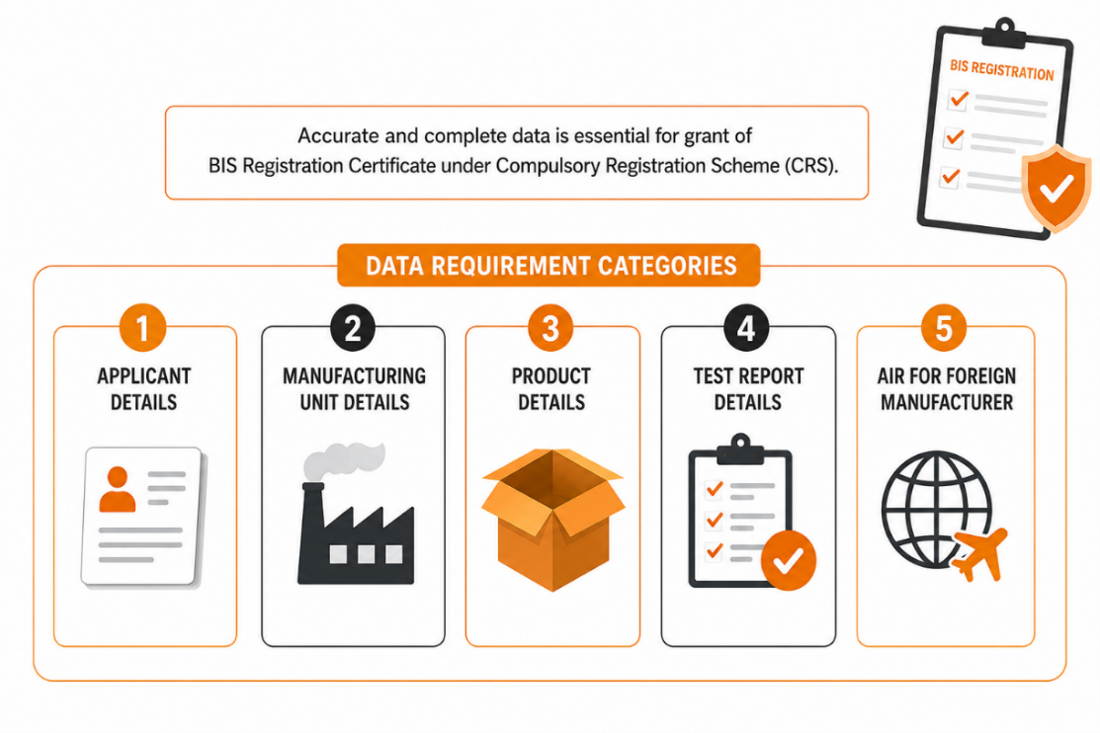
What documents are required?
BIS Registration Fee:
For new application:
Sl. No. | Title | Fee |
1. | Application Fee | ₹ 1000/- |
2. | Annual Licence Fee | ₹ 1000/- |
3. | Application processing fee* (inclusive of 1 test report) | ₹ 25000/- |
4. | Fee for additional test report (per test report) | ₹ 20000/- |
Fee for Inclusion:
Sl. No. | Title | Fee |
1. | Inclusion fee (inclusive of 1 report) | ₹ 30000/- |
2. | Fee for additional test report(per test report) | ₹ 20000/- |
Fee for renewal:
Sl. No. | Title | Fee |
1. | Application Fee | ₹ 1000/- |
2. | Annual Licence Fee | ₹ 1000/- |
3. | Renewal processing fee * | ₹ 25000/- |
4. | Additional fee in case renewal is requested for more than 2 year (to be charged per year)* | ₹ 25000/- |
* Concession in processing fee of 80 % shall be applicable to micro enterprises and start-ups, 50 % shall be applicable to small enterprises and 20 % shall be applicable to medium enterprises till 31st May 2029 and 20 % shall be applicable to all enterprises from 1st day of June, 2029 onwards.
Key Penalties and Legal Consequences
- Fines: Initial offenses carry a fine of no less than ₹1,00,000, while subsequent offences can lead to fines of ₹5,00,000 but may extend up to ten times the value of goods or articles produced or sold or offered to be sold.
- Imprisonment: Up to two years for selling, manufacturing, or importing goods without the mandatory BIS mark.
- Seizure and Action: The BIS can conduct raids, seize products without the mark, and initiate legal action.
- Stop-marking/Sales Ban: Authorities can ban the sale of products, order product recalls, and cancel BIS licenses.
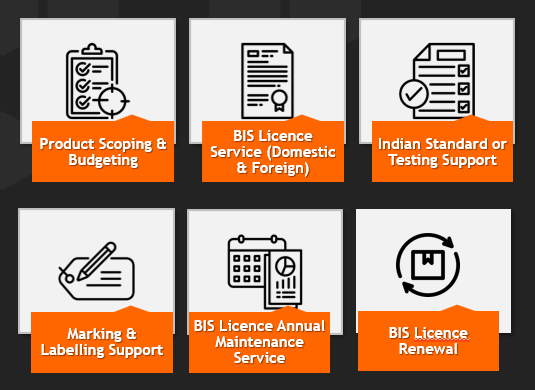
Our Support with Compulsory Scheme II
Why REACHLaw?
REACHLaw: Trusted Global Experts in Chemical and Product Regulations
REACHLaw is an international regulatory consultancy, trusted worldwide for delivering expert, practical, end-to-end compliance solutions in chemical and product regulations. Since 2008, we have helped the global chemical industry and related sectors to achieve compliance and a smooth, timely, and sustainable market access for their chemical products. Headquartered in Helsinki, Finland and with offices across Europe and Asia, we support over 1,000 clients from more than 60 countries, providing tailored, actionable solutions for complex compliance challenges.
BIS Compliance in India – Trusted BIS Partner
Through REACHLaw India Pvt. Ltd., with offices in New Delhi and Mumbai, we provide comprehensive Bureau of Indian Standards (BIS) support – as an Authorized Indian Representative and full-service regulatory partner.
From licensing and representation to post-certification support, our long-standing presence in India and close engagement with BIS authorities ensure efficient, reliable outcomes for both local and foreign manufacturers.
Partner with REACHLaw India for trusted BIS compliance expertise, regulatory foresight, and seamless market access to India and worldwide.
Need Support?
Contact us at indiabis@reachlaw.fi